Università degli Studi di Brescia develops a photonic “switch” that paves the way for optical transistors
A major breakthrough in the field of photonics comes from Università degli Studi di Brescia, which has played a leading role in an international research effort resulting in the development of an innovative “switch” capable of controlling and modifying the properties of light at ultrafast speeds, up to 100,000 times faster than current technologies.
The discovery marks a decisive step toward the creation of optical transistors, key components for building ultrafast computing systems and communication networks based entirely on light.
The work was carried out by researchers at Università degli Studi di Brescia, including Professor Maria Antonietta Vincenti and Professor Domenico de Ceglia, as part of an international collaboration led by Professor Marcello Ferrera of Heriot-Watt University in Scotland. The project also involved the Università dell’Aquila and Purdue University, along with other international research centres.
At the heart of the study is a device that works as a photon selector: a system capable of opening and closing the passage of light and controlling one of its fundamental properties: polarization, the direction in which light waves oscillate.
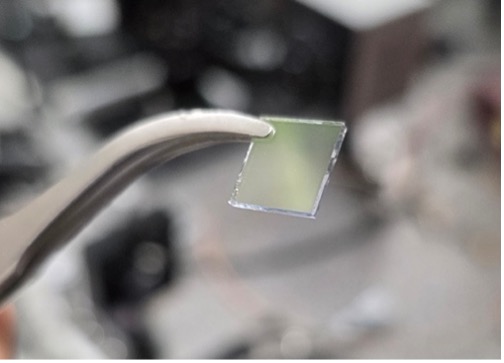
The device operates on extremely short timescales, on the order of just a few tens of femtoseconds, millionths of a billionth of a second, thanks to ultrafast laser pulses. It is a “dynamic polarization rotator” made from an ultra-thin film of conductive aluminium-doped zinc oxide, or AZO, whose properties are modified directly by light, without the need for magnets or complex electrical circuits.
“In this way, we ‘program’ the material using light itself, temporarily obtaining a device that responds differently depending on the direction in which the light propagates. For a few femtoseconds, the film becomes a kind of fully optical diode,” explains Domenico de Ceglia of Università degli Studi di Brescia.
Controlling polarization on such short timescales has long been one of the major challenges in photonics, particularly with a view to device miniaturization.
“This device, capable of modulating light at incredibly high speeds — up to 100,000 times faster than today’s electronic transistors — represents a breakthrough of extraordinary importance,” says Maria Antonietta Vincenti of Università degli Studi di Brescia.
The research opens up new perspectives for the development of advanced photonic technologies and strengthens the role of the Università degli Studi di Brescia on the international stage in research on materials and devices for controlling light.
Article available here: https://doi.org/10.1038/s41566-026-01886-3